Tuesday, 5 February 2013

Outdoor Constructed Textiles


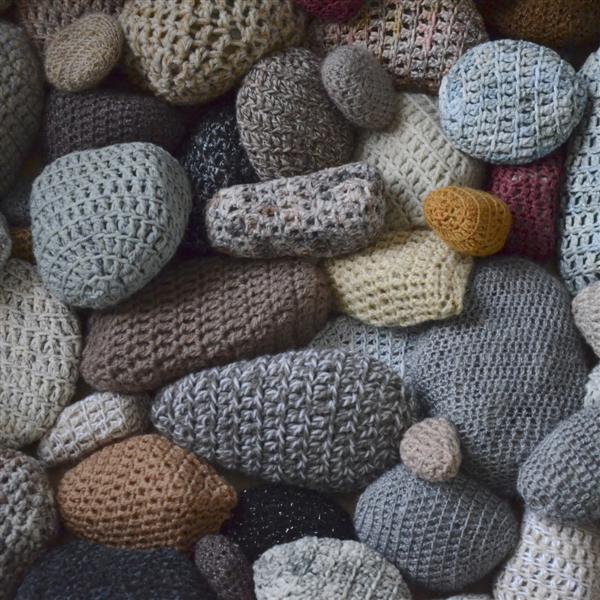
This work is by Hannah Streefkerk, I came across her on the 62 group website and find her outdoor installation work incredible.

"Hannah reduces the natural environment to patterns, rhythms, forms and structures."


I like this work for similar reasons as to why I liked the 'stitched ceramics' which I previously posted. I like how stitching (something perceived as delicate and associated with fabric) can be transferred into a completely different environment. The stitching into the trees is extremely interesting and it makes you question how it is achieved. I would be wanting to go up to the work and to see exactly how it was created. The large scale construction brings textiles and nature together making them appear blended, like they are supposed to be together. 
Hannah's knitted or crocheted rocks and stones are also very interesting to look at, from far away they would look like natural stones but it's not until you get closer you realise they are textile constructed objects.
Hannah's work has a very 'blending' finish to it, the work blends in with the environment it was created for. This is something I will look at with my samples, thinking more about the finish of them and where I would like them to be seen and therefore how this would effect the finish. Again, the work makes me think more about materials and how I could think outside the box in order to create something quite unique and individual.

Image and text reference:

Manipulated Materials


This work is by Ann Goddard, she explores ideas through making and working directly with various materials. I've included the images of Ann Goddard's work that I find most interesting in terms of material and manipulation.


Ann works a lot with paper and wire. I like how she constructs her work and I the pieces she creates are quite small and intricate. Her use of wire and paper together must have taken a lot of practice to get right but it allows you to manipulate the final structure of the piece into ways you might not have before thought about. This makes me think about how I can use a thin wire within my sample work and see how I can then manipulate the sample afterwards. I am currently thinking about how I can put wire into my weaving work.
Ann's work appears very natural and old looking, as though it is inspired by nature. My work is inspired by nature so I would like to bring these delicate qualities she uses in her work through to mine.

Text and Image reference:

Kirsty Whitlock

Kirsty Whitlock is a mixed media textile artist who specialises in embroidery but pushes her use of materials and application to 'break the preconception of textiles'.

"I don't want to be delicate with machine work I do. I want to reflect my drawing work and expressive mark making"

Kirsty uses recycled materials in order to highlight the 'throw-away' culture of our society. She produces a number of different interior accessories including cushions, lampshades, framed piece and also installation work and as you can see from the piece of work above, she addresses various issues within her practise.


The two images above I really love. I love the textile feel of Kirsty's work. The fact that her work doesn't come across neat and tidy with various loose, unorganized threads relates more to an expressive, drawing quality. I like the fact that the work isn't precious, it's very experimental with mark making and textural qualities. 
Looking at Kirsty's work has made me think more about how I can create this tactile effect in my work. As I've said before there is a lot of 'trapping' in my work and I have recently created a piece of work using wire which has a controlled quality, but also a much looser quality with various threads draping around the wires. The work reminds me of what I am seeing here and I am therefore thinking about how I can move it forward into more samples maybe using recycled materials.

Image and Text reference:
www.kirstywhitlock.com

Wallace and Sewell


Wallace and Sewell is a woven textile design studio which was set up by Harriet Wallace-Jones and Emma Sewell. The textiles they create are for fashion and furnishings and they have also been commissioned for much larger projects.


The two designers won a commission to design new upholstery for London transport. Two designs were chosen containing just four colours each.


"We tried to confuse the eye, so that there seems to be more colour in the work, than just the actual four colours, creating designs that seem random through repetition"
Wallace and Sewell work with a number of other people, for example the are collaborating with Luisa Cevesa, an Italian accessories designer. She traps stripes of fabric between transparent plastic and works with Wallace and Sewell's offcuts. They also collaborate with a designer called Tamsin Howells who traps fabric between perspex to create jewellery.


I find Wallace and Sewell's use of colour very inspiring. It reminds me of Margo Selby's use of colour which I looked at in my previous post. The use of colour is very bold and eye-catching and it's something that I like to be able to do in my work - draw people in with my use of colour. I find it quite interesting that the designers only used four colours in their London transport project which makes me think about how I can use a limited colour palette effectively.
I like the work that Wallace and Sewell are doing with other designers. There is a lot of 'trapping' involved and this is something that comes up in the imagery I am working from in my current project. This has therefore made me think of other ways I could 'trap' things in my samples and using untraditional materials to do so.


Text Reference:

Image reference:
www.wallacesewell.com

Monday, 4 February 2013

Margo Selby

Margo Selby develops the construction and texture of fabrics on handlooms which is used as a basis for her textile products/projects. Margo combines hand-woven structures with industrial machinery in order to create a unique range of 3D fabrics, as seen in the images I've included.


Hand weaving at the development stage gives Margo an understanding of how different materials behave and how they would impact on a final fabric. Margo creates a number of samples in order to test fibre and construction ideas. Patterns would have been created from rough sketches and computer design programmes. The handwoven fabrics are applied to CAD drawings and the final chosen fabrics are produced at a specialist mills. The fabric is then taken back to the studio and made into various products. 
The products Margo creates range from interior accessories, fabrics, wallpapers, rugs and furniture to jackets, scarfs, ties, shoes and clothing accessories.


I really love the colour that Margo Selby uses in her products. They are all big and bold, it is quite interesting that she uses block colours and builds up pattern and texture. Margo Selby has obviously worked hard on one specific thing that she enjoys, weaving, and has managed to create a unique style and design. She experiments a lot with various materials to see how they work on larger scales and how different materials play of each other. This in depth experimentation with materials has made me think more about bringing it into my studio practise as there is a large amount of knowledge to be gained by testing a material and seeing what you can do with it.
I think that Margo Selby's jackets are very interesting as the fabric changes completely when laid on the human body. It gives the piece a different feel, the fabric looks a lot more structured and almost architecturally inspired. This makes me think about the 'posture' of my samples and how the positioning of them can give a whole other dynamic to the piece rather than it being kept flat.

Text and Image Reference:
www.margoselby.com

Stitched Ceramics


I found this image in the Mix Magazine and it immediately caught my attention. The juxtaposition of something very delicate against something very hard and structured is interesting. You would associate stitch work with fabrics or supple material, in this case ceramic bowls have been 'stitched into'.

I would imagine that the holes would have been made during the time the pots were created and then thread would have been weaved in and out through the holes. I love the fact that the threads have been left to fall from the bowls and not cut short, adding another delicate, textile quality.

I love this piece of work and believe it is created by Cath Ball. This work will inspire me look more at how different materials work together and how you could get two totally different materials/techniques and combine them. 

Image Reference: Mix Magazine, Issue 27, 2012

Sunday, 3 February 2013

Helen Amy Murray

Constructed Interiors.

Helen Amy Murray creates beautiful 3D upholsteries, such as this...


They are all hand crafted and manipulated, inspired by nature and form. Helen works materials like leather, suede and silk, as you can see the chair above is 'sculpted' from leather.

Fish Scales Chair
"As a designer I am always thinking about how I can create unique and innovative luxury textiles that create an illusion for the viewer, because I achieve a sculptural aesthetic usually associated with solid materials."

Helen creates work for small, private residences and larger, commercial projects through interior and architectural practices. As well as bespoke upholstery, Helen creates wall coverings and framed wall pieces.

Felt Wall Piece

Sea Life Chair 

Helens work is very complicated and detailed. It looks like work produced with a laser cutter, but it is all hand crafted. I like the subtle 3D appearance, it reminds me very much of Karen Nicol's work (see a previous post). 
This is an approach I would like to try and use within my work. Something subtle, but incredibly effective, becoming part of the fabric/interior.
As you can see Helen uses a 'clean' colour palette. She sticks mostly with single, pale shades. This allows a blank canvas to work on and doesn't take away from the intricate work Helen creates. This is something I will experiment with on my sample work, plain/monotone fabrics worked into with, maybe one, contrasting colour.

Peacock Chair

Text and Image Reference: